
San Francisco County Recent Arrests
The first official trail depends on how far an arrest has progressed. SFPD officers and other agencies create the arrest information. The Sheriff's Office then books anyone accepted into county custody. That happens at County Jail #1, the Intake & Release Center. From there, the Sheriff's Find a Person in Jail tool is the current-custody starting point. It is not a log of every police contact or citation. Nor does it promise a fixed posting time for new bookings.
The Sheriff publishes no same-day public booking page. SFPD policy does call for a daily Form 307 arrest-information period. That form circulates internally. It is not a public morning feed. So the practical windows differ:
| Window | Best route | Scope | Limit |
|---|---|---|---|
| Same day | 24 Hour Arrests | Form 307 reporting and current custody checks | A fresh arrest may still be processing |
| Several days or months | Arrest Log | Republished forms and requested records | Publication can arrive in delayed batches |
| Current custody | SFSO locator | People booked into county custody | Not a full history or court outcome |
An arrest entry is only the start of a record. Verify the identity first. Then turn to the San Francisco Superior Court docket. That file holds the case disposition, which is what actually settles the outcome.
When New Arrests Appear
Arrest time, jail acceptance, booking completion, and online display are four separate events. County Jail #1 handles the intake and release processing. Identity checks and medical screening come first. Property handling, fingerprints, and data entry all follow those early steps. A name becomes searchable in the Sheriff locator only after that. SFSO posts no fixed refresh interval. A missing result right after an arrest proves nothing about release.
Start with the date and the arresting agency. Search the roster under more than one identifier if you can. For a time-sensitive welfare or custody question, call the jail information line at (415) 553-1430. For the long term, a targeted records request is the fallback. It can go to SFSO or SFPD. The official Intake & Release Center page explains where county processing begins.
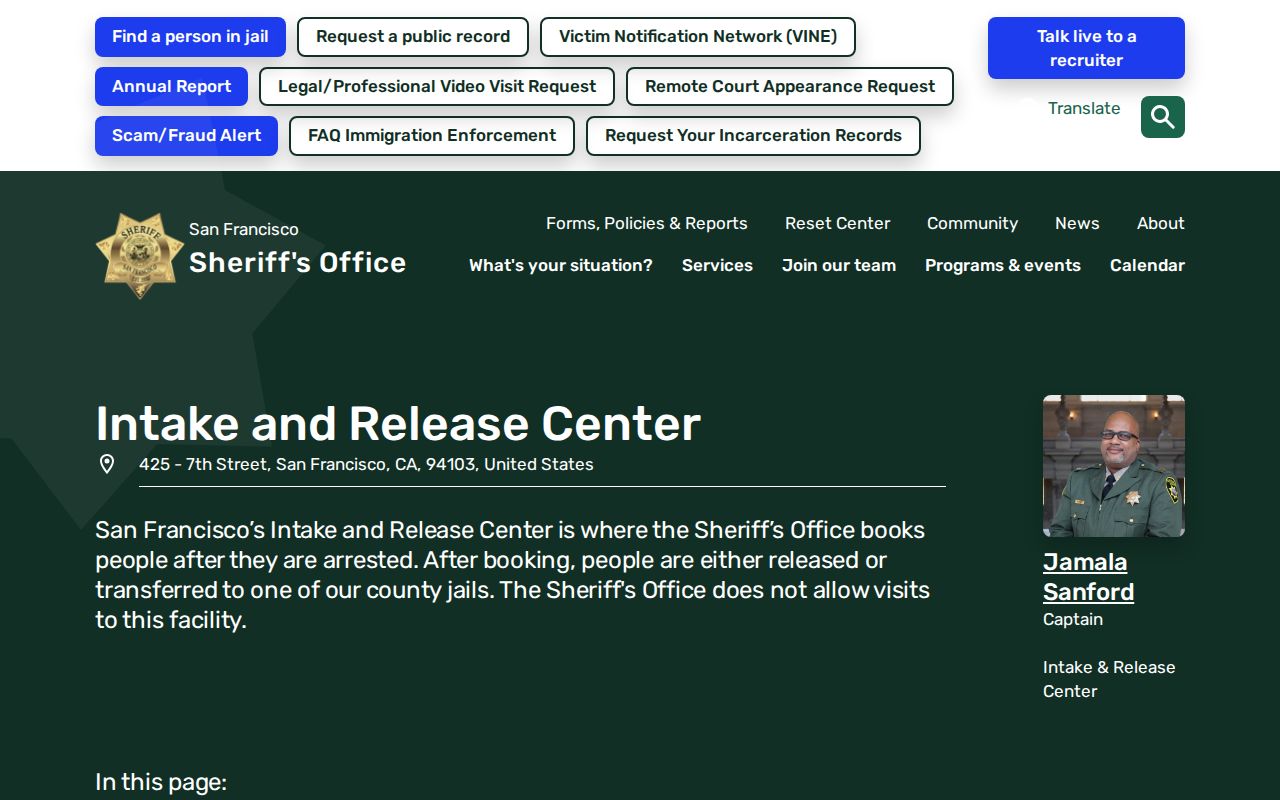
Its information helps distinguish initial processing from later housing in another county jail facility.
Search the County Jail Roster
The locator supports three search modes. A name search needs at least the first three letters of both names. An SF number is the Sheriff's permanent personal identifier. A booking number points to one booking event. Those two numbers shine when a common name returns fuzzy matches.
| Search field | Use | Details to compare |
|---|---|---|
| First and last name | Start without a known number | Name, age, booked-on date |
| SF number | Distinguish an individual | Facility, court and booking data |
| Booking number | Find one intake event | Booking date, bond, docket |
A result card may list age, facility, SFNO, booking number, the booked-on date, total bond, next court date, court department, and docket details. It shows no booking photograph. The tool is not a mugshot gallery. Nothing public states how often it refreshes or when a released person's entry disappears.
- Open the official locator and choose a search mode.
- Enter the exact number, or the required name fragments.
- Compare identifiers and dates before assuming a match.
- Review the facility and next-court fields.
- Call the jail line when an urgent change has not reached the web result.
The official SFSO locator capture shows the search interface rather than a person’s record.
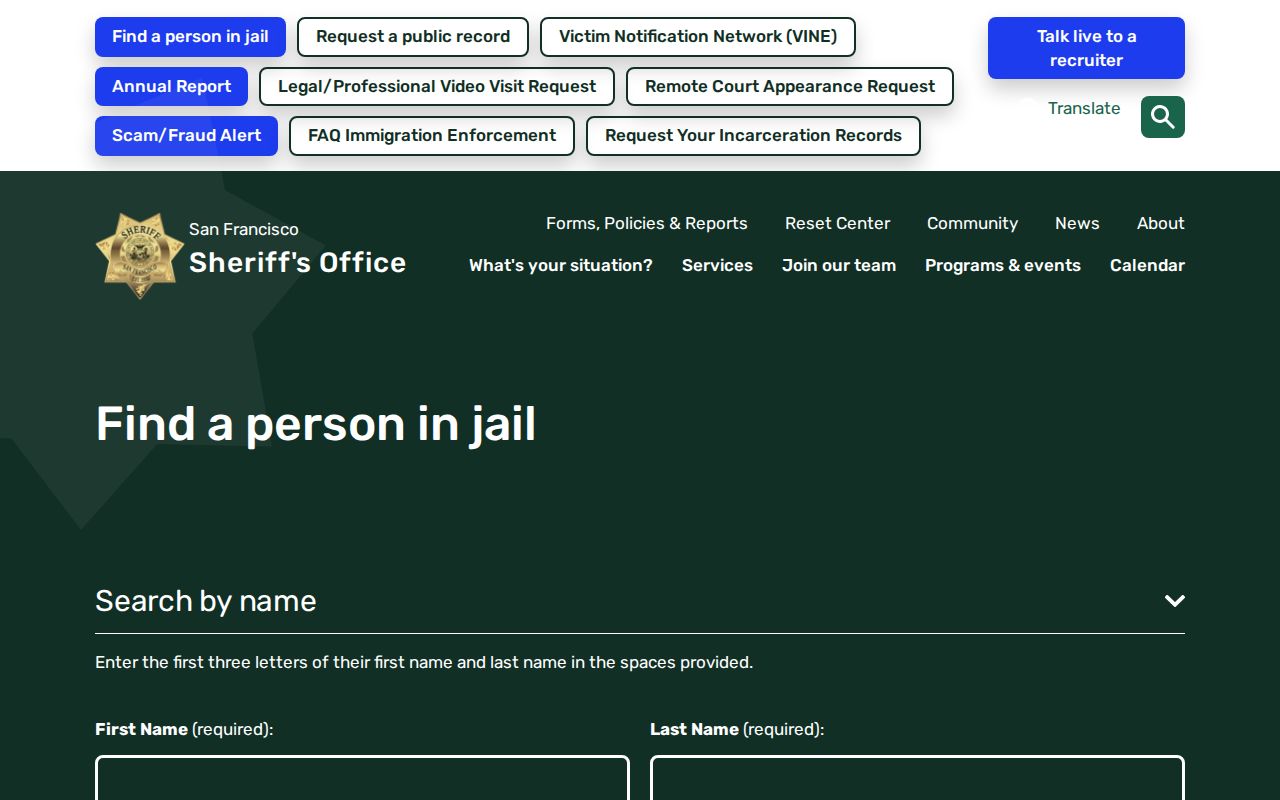
An SF number beats a name search. A booking number works too. Either one pinpoints one arrest record in the San Francisco County system.
Release Timing After Arrest
San Francisco's own-recognizance process adds local context a roster cannot show. Pretrial Services aims for a release recommendation within eight hours of booking. That figure comes from SFSO. A judicial decision should follow within 18 hours. A 12-hour extension is possible. Those are process targets, not a promise of when any arrested person leaves custody.
Charges, holds, warrants, and identification problems can all reroute the timeline. Medical needs can too. A judge's call can as well. "Booked" means the jail opened an intake record. "Released" means county custody has ended, even if the case continues. The roster can lag either event. A VINELink custody check can send release or transfer alerts once you register.
| Status | Check | Does not prove |
|---|---|---|
| Arrest reported | SFPD report | County booking is complete |
| Booked | SFSO locator | Guilt or final charges |
| Released | VINE, SFSO, court | The criminal case ended |
Where Arrest Records Are Published
Official channels come first. Each exists for a defined public purpose. News outlets and commercial sites may copy only part of a record. They can miss a correction or leave an old item standing after the roster changes. None of them replaces agency or court confirmation of a San Francisco arrest.
| Channel | Official? | Photo? | Scope |
|---|---|---|---|
| SFSO jail locator | Yes | No in current result | Current custody and booking fields |
| SFPD Form 307 | Yes from SFPD | No verified public photo feed | Daily police arrest fields |
| DataSF jail bookings | Yes | No names or photos | Aggregate monthly counts |
| Local news archives | No | Varies | Stories or secondary copies |
| Commercial aggregators | No | Varies | Potentially stale or incomplete copies |
The catalog entry for Sheriff Jail Bookings describes the aggregate dataset.
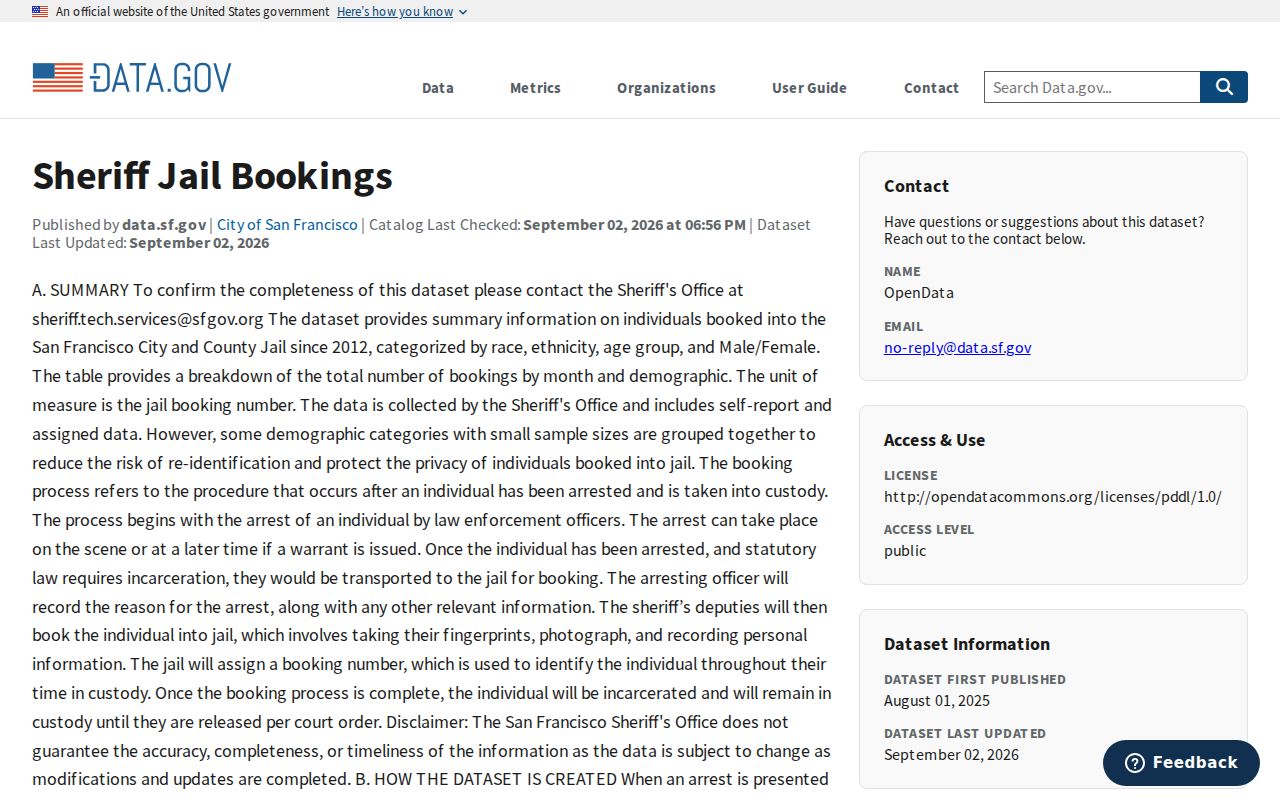
Grouped arrest totals can support trend research. They cannot identify who was arrested. They also cannot confirm present custody. For that, the county's own tools do the work.
Recent Arrests by City
San Francisco is a consolidated city and county in one. Census incorporated-place data lists San Francisco as the county's only incorporated city, so separate suburban city pages would misstate the jurisdiction. SFPD and other agencies make the arrests. SFSO runs county booking and custody.
- San Francisco Recent Arrests covers the SFPD report path, Sheriff booking destination, city records offices, and local publication channels.
San Francisco Arrest Record Fields
A police arrest report and a Sheriff booking record overlap, but they are different files. Form 307 can list arrest time and name. Address, birth date, sex, charges, arrest location, and the case or arrest number may appear too. A booking record adds identifiers and custody details created at jail intake. Sensitive material may be withheld. That includes sealed, juvenile, medical, and investigative facts.
| Field | Meaning |
|---|---|
| Name and identifiers | Compare carefully to prevent a false match |
| Arrest and booking dates | Separate stages with different times |
| Charges as booked | Intake charges, not conviction |
| Facility and bond | Custody location and listed release amount |
| Court date and docket | Links the booking to court |
| Booking photograph | An intake image with separate access rules |
Charges do not stay frozen. They may be amended, reduced, dismissed, diverted, or end in acquittal. The court disposition is the reliable endpoint. Check the San Francisco court record for it.
County Mugshots and Booking Photos
The San Francisco Sheriff's Office locator shows custody facts but no booking photo. A mugshot may still sit in the underlying file, though. Ask the record custodian for the image itself. That request can draw a different answer than one for basic booking details. California law leaves room for law-enforcement exemptions and privacy limits. Release is never guaranteed.
For state-prison custody, CIRIS exists. The California Department of Corrections and Rehabilitation runs it. A CDCR photo is not the county image from arrest day. CIRIS also misses anyone still held in county jail. It misses anyone cited and released, too. Commercial sites copy booking photos and repost them. Those copies are unofficial and often stale, so official channels still matter more.
Request a County Arrest Record
Start at the SFSO public-record page. It routes requests through GovQA for Sheriff records and photographs. Keep the ask tight. Name one person or booking. List each record type. Request electronic copies when the office keeps them that way. SFSO promises neither a booking-photo release nor a fixed production date.
- Give the full name and known SF or booking number.
- Provide a narrow arrest or booking date range.
- List the booking record, photo, log, and release field separately.
- Ask for segregable non-exempt portions.
- Request the legal basis for withholding, a fee estimate, and estimated production date.
SFPD keeps police incident and evidence records under different rules. Its current instructions send incident reports to Records Management at 1245 3rd Street. Photographs and evidence go through the ID Bureau's public-records path. Treat older mugshot-window instructions as historical until the department confirms them. For county records, check the Sheriff request page. It shows the current route.
The portal serves one defined record. It is not for bulk images. Request a specific San Francisco arrest record, not a broad photo sweep.
California Arrest Photo Law
The California Public Records Act leans toward access. Yet it protects law-enforcement files, privacy, juvenile matters, medical data, active investigations, and sealed records. Government Code §7923.600 covers investigative and similar police files. A basic arrest log, a full investigation, and a booking photo are not the same. Each can land in a different bucket.
Civil Code §1798.91.1 forbids a charge. A booking-photo publisher cannot demand money or anything else to remove, correct, or withhold a photo or its details. Stick with courts, agencies, and free publisher channels. Penal Code §13665 restricts how agencies share certain booking photos on social media. It does not force a roster photo onto anyone. Nor does it erase the booking file.
Correcting an Arrest Photo Online
People call four different things "removal." An agency can correct its own record, or a court can order dismissal, sealing, or similar relief. A publisher can run a free correction process. A search engine can refresh a stale result once its source changes. Fixing one layer never promises that every independent copy vanishes.
Start at the source. Bring the booking number and arrest date. Add any court documents too. California Courts' Clean Your Record resource states plainly that no single process wipes every record. The CR-180 petition works only when eligibility rules are met. Penal Code §851.87 opens a route in specified cases.
Once an official URL changes, file the outdated-content request with the search engine. If the source page still shows the item, deal with it first. Mugshots.com describes free record maintenance. RecentlyBooked links a general free policy, though neither publishes a San Francisco-local page. Jail Exchange points visitors back to SFSO. Never pay a publisher to take down a booking photo.
Arrest Warrants and Wanted Notices
The Sheriff's Office publishes no online warrant-search portal for the public. An older Sheriff FAQ names the Central Warrant Bureau. It sits at the Hall of Justice. The city directory lists (415) 553-1871. Confirm both details before leaning on them. Anyone worried about an arrest warrant in San Francisco should turn to the court. A defense attorney can also help. The Bureau itself can check and resolve it.
The SFPD Most Wanted page and Northern California Most Wanted post wanted-person notices. These are not recent-arrest lists. Entries can sit there for years. Never approach someone listed. Call 911 for immediate danger or use the agency's tip line instead. The official SFPD source appears below.
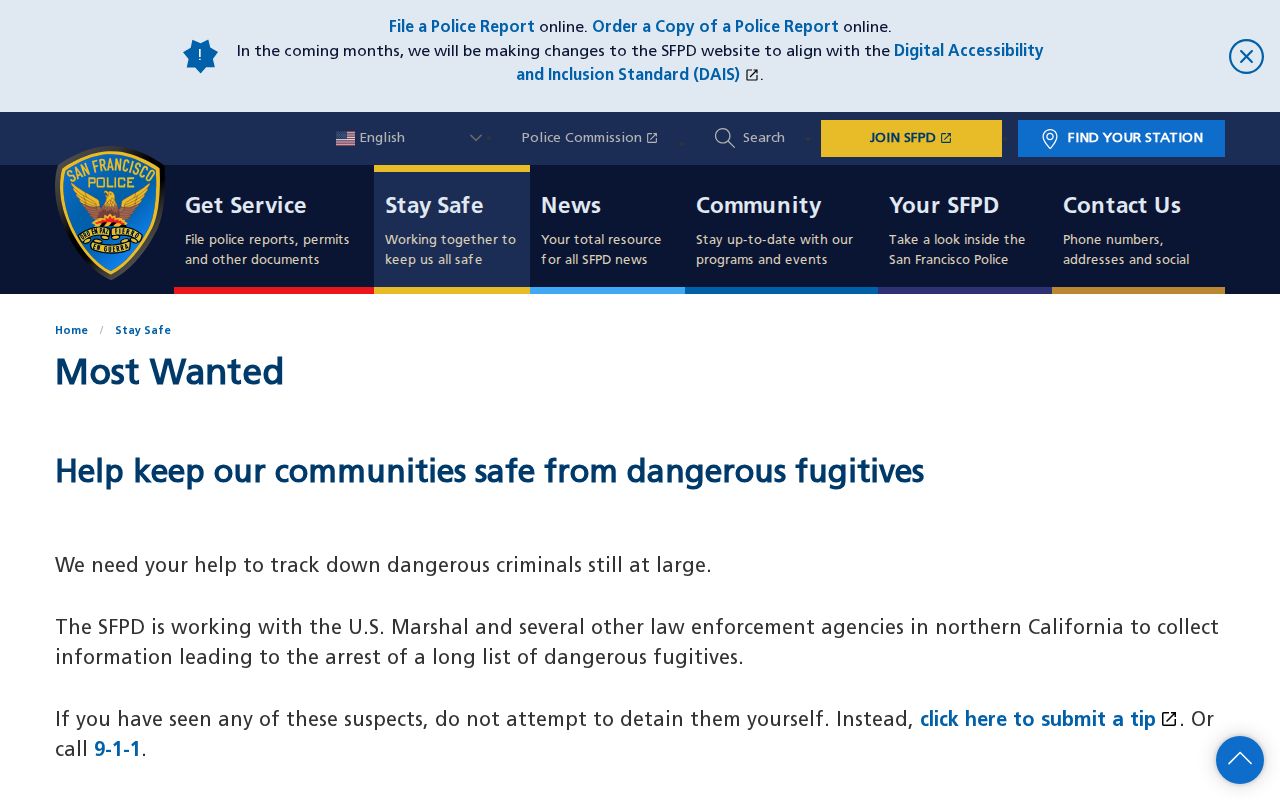
Use it for current agency instructions, not as proof of booking or conviction.
After a San Francisco Arrest
An arrest in San Francisco starts a legal chain. Booking comes first. The jail logs the person and takes a booking photo. Arraignment follows as the first court appearance, where charges and release terms are addressed. If the court sets bond, that financial condition governs release. The disposition closes the case. It might be dismissal, a plea, diversion, conviction, or acquittal. None of those later events appear on the live roster. Use the Superior Court case-information service to follow the file. Search with allowed identifiers, confirm the case number, and tell the filed counts apart from what the arrest report first claimed.
- Booking
- The jail intake and record-creation process.
- Arraignment
- The first court hearing on charges and release.
- Disposition
- The recorded outcome, not the original charge.
- Sealing
- A limit on public access when legal conditions are met.
Older San Francisco Arrest Records
A live custody search tool is not an archive. Once a person is released, the trail moves elsewhere. In San Francisco, the follow-up paper usually means a booking record, Form 307, a police incident report, a court file, or an archival collection. The city's multi-day arrest-log republication can pinpoint a reporting period, but it is not a promise of permanent retention. Its posting date can also drift from the arrest dates listed on the underlying form. That gap matters at a half-month batch edge.
Start an older search narrow. A known case, arrest, booking, or SF number beats a broad date sweep every time. Ask SFPD for anything police created and SFSO for the jail's booking paperwork. The Superior Court keeps the case file that followed. When normal agency retention runs out, the California State Archives reference service and San Francisco archival descriptions can point to historical government collections. A catalog hit only proves a collection exists. Access rules, indexing, and record-level limits still need confirmation.
News databases can help too. The San Francisco Chronicle archive, for one, may surface a publication date or a story printed soon after the arrest. Treat them as secondary sources. A story filed before arraignment can miss later facts. Match names and charges against the official record.
Retention is one thing; visibility is another. A record can stay on file with an agency long after it drops from a public-facing tool. A sealed record can still sit in a government database while public access stays limited. California DOJ notes that criminal-justice access can survive a sealing order. So ask each custodian three things: what it holds, what it can release, and which law supports any withholding.
Custody Beyond County Arrests
County, state, and federal locators answer different questions. CIRIS tracks California state-prison custody and may show an offender image. The BOP locator covers federal prison custody and posts no inmate photos. ICE runs its own detainee locator. U.S. Marshals pretrial custody may never show up as a normal BOP result.
People leave SFSO custody through release or transfer. That fact alone says nothing about the destination. Compare the local record, a VINE alert, the court docket, and the receiving agency's locator. CDCR victim services sit apart from county VINE. No federal locator supplies the original county booking photograph.
Does a missing roster result prove no arrest occurred? No. Booking may be pending, or the person may have been cited, released, transferred, or logged under details that don't match the query. Confirm with the agency and court.
Check San Francisco Arrest Records
Use exact names and identifiers when available, then verify the result with its originating office.
Sponsored Results
San Francisco Sheriff’s Office Location and Directions
San Francisco Sheriff’s Office
1 Dr. Carlton B. Goodlett Place, Room 456San Francisco, CA 94102
415-554-7225